Sam Harrison in Fast Company provides 12 great tips for selling ideas from his book IdeaSelling: Successfully Pitch Your Creative Ideas to Bosses, Clients and Other Decision Makers. Here’s a brief summary.
1. Collaborate with your clients and let them take credit for your ideas.
2. Pitch ideas with a clear and logical flow.
3. Pause before you start speaking to build anticipation.
4. Never start your pitch with “You’re going to love this idea.”
5. Help clients visualize.
6. Keep it short.
7. Skip handouts.
8. Invest in leave-behinds
9.…
When I am embarking on a new innovation consulting project, I like to go back and re-read my notes from works that never lose their relevance and continue to resonate with clients.
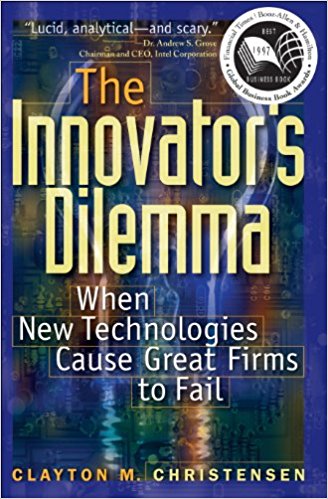
Notes from Clayton Christenson, The Innovator’s Dilemma
It pays to be a leader in a disruptive innovation
• Leadership in sustaining innovations gives little advantage
• Leadership in disruptive innovation creates enormous value
But established companies typically fail in the face of disruptive change
• Companies get organized to satisfy current customer’s needs and to…
An innovation project team approached me last week, well into the solution development phase of the program:
“We’ve run into a bit of a crossroads with respect to defining the scope of our project. We’ve come up with 2 outlines (full details attached)…The group thinks that both ideas have merit; although the main focus of each project is quite different. Given that we haven’t been able to come to a consensus as a group, we were hoping to talk through both ideas with you on Monday.”
Both ideas aimed to…
The young “high-potentials” I often work with at my financial services clients tend to be a confident bunch. Some of them sell complex products and services to very sophisticated clients who will eat them for lunch if they sense hesitancy or uncertainty. Others constantly make high stakes decisions in rapidly changing markets, dealing with uncertainty and managing risks. Selling and trading things they know well, they are very good at what they do.
But the innovation programs I run put them into a very different situation. They are asked to…
This week marks the midpoint of an innovation program and I repeated to the teams Rosabeth Moss Kanter‘s “law” that every innovation will look like a failure at some point in the middle. The difference between success and failure is how long people persist before they give up. One of the reasons she cites is that people get tired and discouraged in the middle. This can be especially true when people are asked to work on innovation projects in addition to their full-time day jobs.…
Imagine your manager nominates you for a high-profile leadership development program. You find yourself on a team with four people you’ve never met and know nothing about except that they, like you, are very smart, very driven and management calls them “high potential.” Your team comprises people from different continents and different businesses and who face different customers. You have three months to develop a proposal for an innovative new product or service that you will pitch, as a team, directly to the most senior leaders in the organization. What…
Last October we wrapped up a five-month innovation/leadership development program for 50 participants at one of our financial services clients and we have just received the three-month status report on the projects.
Seven of the nine projects pitched to senior management at the closing session are now moving forward. These include an outsourcing solution in Brazil that has already garnered significant interest there and in other regions, a cross-border service for benefits payments (this came from one of the most geographically diverse teams representing Argentina, Italy, Dubai and the US…
“An overwhelming majority of surveyed executives (88%) fear they will not have the necessary talent to lead their innovation programs after the recession ends,” reports Deloitte Consulting in the results of a recent survey of 325 international executives on talent trends and strategies. “Companies may soon find themselves in a fight for talent as the recovery takes hold….To excel during changing times and the economic recovery, we believe organizations must take an offensive approach, implementing talent strategies dedicated to driving innovation.” said Jeff Schwartz of Deloitte.…
At the beginning of this year when the markets were not being kind to our financial services clients, we admit we were concerned that the crisis would relegate spending on innovation programs for relatively junior employees to the long list of “necessary” cuts. It didn’t. In fact, our clients have expanded the number of programs they run. Their reasoning is sound though it may not be obvious.
Much has been written this year about the importance of innovation in a downturn. Those firms that continue to invest in strategic innovation…
Here’s an interesting juxtaposition of data that suggests why we’re not as creative as we’d like to be.
The New York Times published a fantastic infographic, How Different Groups Spend Their Day, that can keep a data junkie like me entertained for hours. The chart shows the results from the American Time Use Survey that asks thousands of Americans how they spend every minute of their day.
You can break down the data to view only certain types of people, e.g., specific…